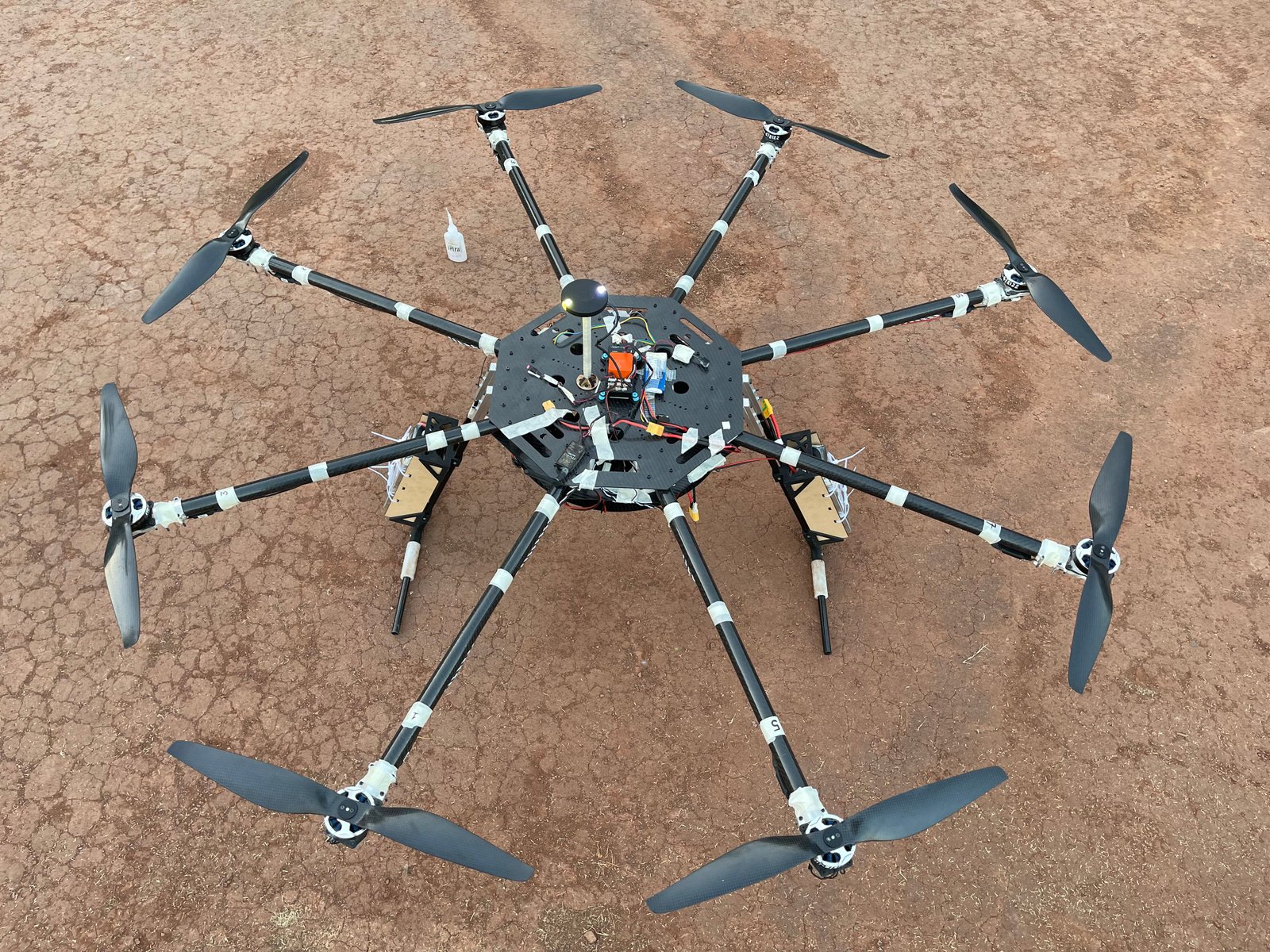
For our first UAV built entirely from the ground up, we selected an octocopter configuration, prioritizing wind resistance and redundancy over other factors. Given the challenges of developing a UAV from scratch, these attributes were crucial for ensuring stability and reliability during flight.
The UAV’s chassis was manufactured in-house using carbon fiber and aluminum, ensuring a lightweight yet durable structure. To enhance flight stability, we introduced a 4-degree dihedral angle in the UAV arms, which marginally sacrificed thrust but significantly improved the overall balance. In addition to the structural design, we also undertook the design and fabrication of several electronic boards, including a custom Power Distribution Board (PDB) and an advanced payload delivery system, marking a significant step in our engineering capabilities.
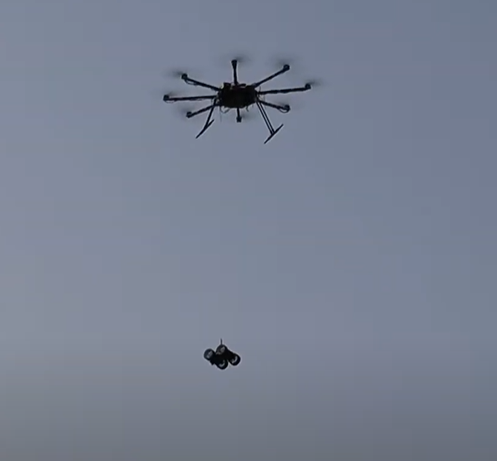
As this was our first attempt at manufacturing a UAV from the ground up, the team had to undertake several
additional steps to ensure a successful production and testing cycle:
Extensive research was conducted on various UAV structures, leading to the selection of an octocopter with
dihedral arms, which provided the best mix of stability and redundancy. The UAV was meticulously designed
using CAD software, followed by stress, vibration, and thermal simulations to validate its structural
integrity. A prototype was manufactured, allowing for extensive bench testing to assess performance under
controlled conditions.
The electronic component layout was carefully finalized to ensure systems operating on different voltages
were properly insulated from one another. Special attention was given to mitigating electromagnetic
interference (EMI) from the high-power propulsion system, ensuring that sensitive electronics like the GPS
and compass remained unaffected.
A comprehensive fail-safe testing process was conducted with the UAV tethered to a rig, minimizing risk
while evaluating the system’s ability to handle failures safely.
Our team previously specialized in fixed-wing UAVs, making the transition to multirotor design a significant
challenge. Unlike fixed-wing aircraft, multirotors offer superior hovering capabilities and greater
precision for payload delivery, making them more suitable for mission requirements involving wind resistance
and controlled drops.
Our journey in developing this first-of-its-kind UAV for our team has been transformative, enhancing our
engineering expertise, problem-solving skills, and system reliability, setting a strong foundation for
future UAV innovations.